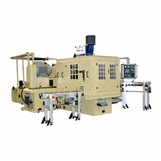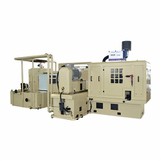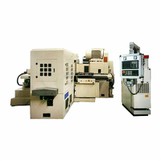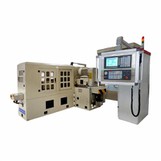


Rushan Shuangxing Machine Tool Manufacturing Co., Ltd. is one of the leading manufacturers and suppliers of discus double grinding machine in China. With abundant experience, our factory offer high quality equipment made in China with competitive price. Welcome to contact us for customized service.
Most metal component shops eventually outgrow single-sided grinding setups. Parts take too long to process, parallelism drifts between batches, and operators spend half their time re-fixturing workpieces. The discus series was developed to address this exact transition point - it brings the efficiency of dual-face grinding to standard production lines, without the complexity and price tag of high-end precision grinding systems.
Built around a straightforward mechanical design and a balanced specification set, this Discus Double Grinding Machine handles the majority of everyday circular component grinding tasks reliably. It is not the fastest, nor the most precise machine in our catalog - but it delivers consistent, repeatable results shift after shift, with operation and maintenance routines that fit naturally into standard workshop workflows.
What Sets This Machine Apart
Three design choices define the practical character of the discus series:
Dual-face processing in a single pass - both workpiece sides receive finishing simultaneously, cutting per-piece handling time substantially compared to sequential single-sided methods
Operator-friendly mechanical layout - controls and adjustment points are positioned for straightforward access, reducing the learning curve for shop floor personnel
Heavy base, balanced drives - a solid cast foundation paired with symmetric drive motors keeps output steady through normal production hours without constant readjustment
Technical Specifications
|
Parameter |
Specification |
|---|---|
|
Workpiece Diameter Range |
Ø40 mm – Ø250 mm |
|
Workpiece Thickness Range |
2 mm – 50 mm |
|
Grinding Wheel Dimension |
700 × 55 × 40 mm |
|
Vertical Grinding Head Stroke |
120 mm |
|
Horizontal Table Travel |
600 mm |
|
Minimum Feed Increment |
0.002 mm |
|
Spindle Speed |
880 r/min (standard) |
|
Spindle Motor Power |
18.5 kW × 2 |
|
Feed Motor Power |
1.5 kW × 2 |
|
Wheel Dressing Motor Power |
0.75 kW |
|
Parallelism Tolerance |
≤ 0.01 mm |
|
Flatness Tolerance |
≤ 0.01 mm |
|
Batch Thickness Consistency |
≤ 0.025 mm |
|
Surface Roughness |
Ra 0.4 μm |
|
Overall Machine Dimensions |
3200 × 2800 × 1800 mm (L × W × H) |
|
Total Machine Weight |
Approximately 10,500 kg |
Note: Tolerance data is measured under standard continuous production conditions with carbon steel workpieces. Actual results may vary based on material hardness, workpiece geometry and operator setup.
How It Improves Your Production Line
Faster Throughput Without Adding Operators
Single-sided grinding requires each blank to go through two separate clamping and grinding cycles to finish both faces. On a typical bearing ring or sealing washer run, this means operators spend a significant portion of the shift handling and repositioning parts rather than actually producing finished components. Dual-face processing eliminates the second setup entirely - parts go in once and come out with both sides finished. For most standard components, this translates to roughly 40-50% more finished pieces per operator hour.
More Consistent Quality Across Batches
Every time a workpiece is re-clamped, there is potential for slight positioning variation. Over the course of a full production run, these small variations add up to measurable differences in parallelism and thickness from piece to piece. Because this machine finishes both sides in a single holding, re-clamping variation is removed from the equation entirely. The result is tighter uniformity across the batch, fewer pieces falling outside tolerance limits, and less time spent sorting and reworking borderline parts.
Lower Daily Operating Burden
Complex grinding equipment with advanced control systems often requires dedicated training and specialist knowledge to operate and maintain effectively. The discus series takes a different approach - the mechanical layout is familiar to anyone with general machine tool experience, adjustment points are logically placed, and routine maintenance tasks are designed to be handled by standard workshop maintenance staff. This means less downtime waiting for specialist technicians and lower long-term operating overhead.
Right-Sized Investment for Standard Work
High-precision specialized grinders are impressive machines, but they carry a price tag to match. For workshops that primarily process standard components requiring 0.01 mm class precision, investing in ultra-high-end equipment means paying for capability you will never actually use. The discus series is specd to match the actual needs of everyday component production, delivering professional dual-face grinding performance at an investment level that makes sense for medium-volume manufacturing operations.
Machine Design & Construction Details
Symmetric Drive Arrangement
Both grinding heads are driven by identically rated 18.5 kW motors, arranged symmetrically across the workpiece. This balance ensures that material removal rates match on both sides of the part, which is essential for maintaining consistent thickness and avoiding the uneven stress patterns that can develop when one side removes material faster than the other. The paired drive configuration also contributes to longer abrasive wheel service life by distributing wear evenly.
Cast Iron Machine Base
Weighing in at approximately 10.5 tons, the main machine body is a single heavy cast iron structure. This mass serves a practical purpose - it absorbs the vibration generated during the grinding cycle, preventing it from transferring back into the workpiece and affecting surface quality. The heavy base also means the machine settles quickly into stable operation and maintains consistent performance across the full length of a production shift.
Independent Wheel Conditioning
A separate 0.75 kW drive handles abrasive wheel dressing, operating independently from the main grinding drives. This separation means wheel conditioning can be fine-tuned to match the specific material being processed without affecting main grinding parameters. Operators can adjust dressing frequency and travel speed to match workpiece hardness and production volume, keeping the wheel cutting cleanly and consistently throughout the run.
Adjustable Motion Parameters
Both the main table feed rate and wheel dresser travel speed are independently adjustable. Feed rate spans from 2 to 10 meters per minute - faster settings for initial stock removal, slower for final finishing passes. Dresser speed adjusts between 0.5 and 1.2 meters per minute. This range of adjustment gives operators enough control to dial in appropriate settings for carbon steel, alloy steel, cast iron and other common workshop materials.
Where It Fits in Production
The discus series finds its place in a variety of standard metal component manufacturing environments:
- General machine shops - washers, spacers, shims and miscellaneous flat disc components across various customer orders
- Automotive part suppliers - standard bearing races, small valve discs, sealing rings and transmission component blanks
- Hardware manufacturing - precision fastener components, metal washers and general hardware items requiring flat parallel faces
- Pump and valve workshops - standard-grade valve plates, pump discs and basic sealing component production
- Contract machining operations - mixed-batch grinding work for clients with different component specifications
- In-house assembly facilities - production of component parts used internally in larger equipment assembly lines
The machine handles common workshop materials including plain carbon steel, low-alloy grades, standard cast iron and routine non-ferrous metals.
The Grinding Process, Simply Explained
Understanding how the machine works helps in getting the best results from it. The principle is straightforward:
Two abrasive wheels face each other on opposite sides of the workpiece. The workpiece sits in a holding fixture mounted on a table that moves back and forth horizontally. As the table reciprocates, both sides of the workpiece pass between the rotating wheels, receiving equal material removal on both faces simultaneously. Because both sides are machined in the same holding, the resulting flat faces are naturally parallel to each other.
For standard production runs, the typical approach is to run an initial pass at higher feed rate to remove the bulk of excess material, then follow with one or two slower passes to bring the part to final dimension and achieve the target surface finish. Operators adjust feed speed and wheel dressing frequency based on the specific material and the starting condition of the blanks.
Available Configuration Options
While the base machine is configured for standard production, several options are available to better match specific workshop requirements:
- Custom workholding solutions - fixtures designed for specific component shapes, unusual blank geometries or particular batch loading arrangements
- Material-specific parameter sets - pre-tested grinding parameter recommendations for shops that primarily work with certain material grades
- Coolant system upgrades - enhanced filtration or higher-capacity coolant delivery for applications with specific cooling requirements
- Dust extraction integration - connection points and compatibility options for facilities running dry grinding with central dust collection
- Semi-automated loading aids - simple mechanical assistance devices to reduce operator handling effort and speed up part exchange
- Multilingual control interface - control panel labeling and documentation in the language preferred by your operation team
Discuss your particular requirements with our sales team, and we can advise which configuration options make sense for your application.
Support & Service Backing
Every machine leaves the factory with standard quality verification and documentation:
- Full-load test run under normal operating conditions for a minimum of six hours before shipment
- Precision verification using calibrated reference workpieces
- Complete electrical safety and functional system check
- Standard operation and maintenance documentation package
- Standard warranty coverage for peace of mind after delivery
- Optional on-site installation guidance and basic operator familiarization available
Common Buyer Questions
What kinds of parts work best on this machine?
It is well suited to flat, disc-shaped metal components that need parallel faces on both sides - things like bearing races, sealing rings, washers, spacers and similar parts in the 40–250 mm diameter range. If you are currently doing this work on single-sided grinders or manual equipment, this machine will typically represent a meaningful step up in both throughput and consistency.
How much faster is it compared to single-sided grinding?
For typical circular components, you can expect roughly 40–50% higher output per operator. The exact improvement depends on your current process, but the core gain comes from eliminating the second clamping and grinding operation that single-sided setups require. Less handling time per piece means more finished pieces per shift.
Do we need a specialized operator to run it?
No. The machine is designed to be operated by personnel with general machine tool experience. The controls are mechanical and straightforward, and the adjustment logic is familiar to anyone who has worked with production grinding equipment. Basic operator familiarization is usually sufficient to get started.
Can we switch between different materials on the same day?
Yes. The adjustable feed and dressing settings allow operators to adapt the process for different material hardnesses. Switching between carbon steel, alloy steel and cast iron typically involves adjusting feed rates and dressing frequency to match the material. The machine is built to handle mixed production common in job shop environments.
What kind of floor preparation is needed?
Standard reinforced concrete factory flooring is generally sufficient. The 10.5 ton cast iron base provides its own stability through mass. We supply foundation drawings and installation guidance with every machine so your facilities team can prepare appropriately.
How long does delivery typically take?
Standard configuration machines generally have shorter lead times as they follow regular production schedules. Customized configurations may add time. For the most accurate timeline, contact our sales team with your specific requirements and expected delivery date.
What support is available after purchase?
We provide standard warranty coverage, spare parts supply, remote technical guidance and optional on-site service visits. Our international support team works with customers in multiple regions, helping with installation questions, troubleshooting and routine maintenance advice.
Is the Discus Series the Right Fit?
The discus double grinding machine is a solid choice if you are looking to move up from single-sided or manual grinding without stepping into specialized high-end equipment. It is built for workshops that need reliable dual-face grinding performance, straightforward operation and sensible total cost of ownership.
If your application demands sub-micron precision, ultra-hard specialty materials or fully automated high-volume production, one of our higher-specification machines may be more appropriate. But for the majority of standard metal component grinding work, the discus series delivers professional results at a practical investment level.
Hot Tags: discus double grinding machine, China discus double grinding machine manufacturers, suppliers, factory, double disc grinding, Double Disc Grinding Machine for Industrial Workshop Equipment, Double Disk Grinder, precision surface grinder, table top surface grinder, vertical surface grinding machine