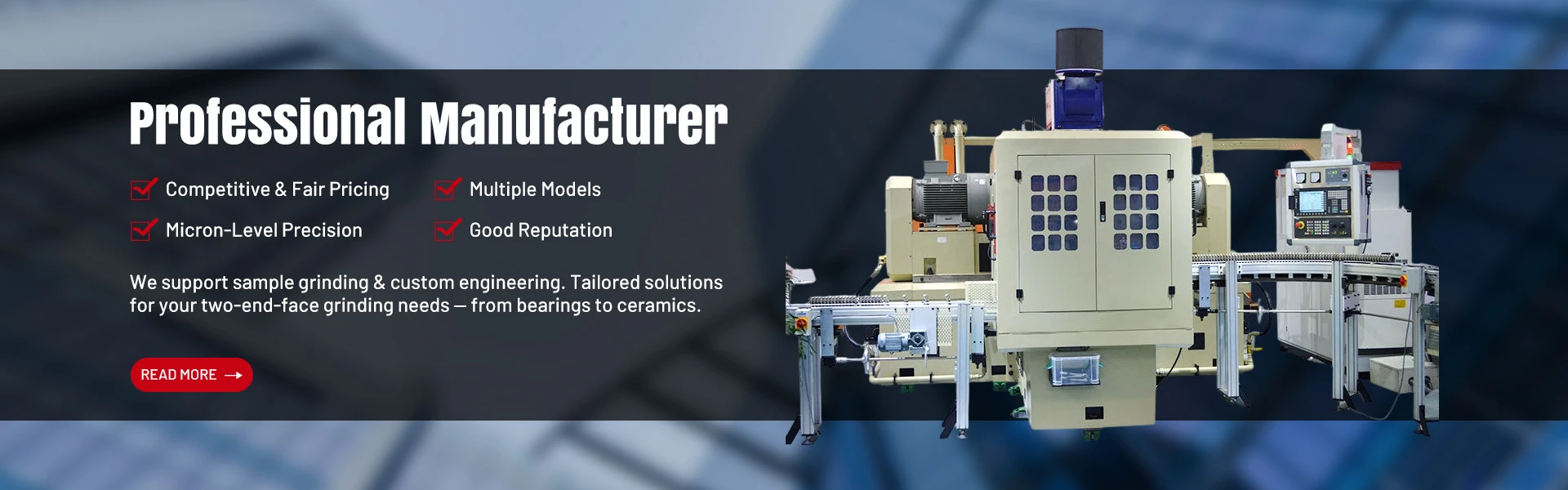

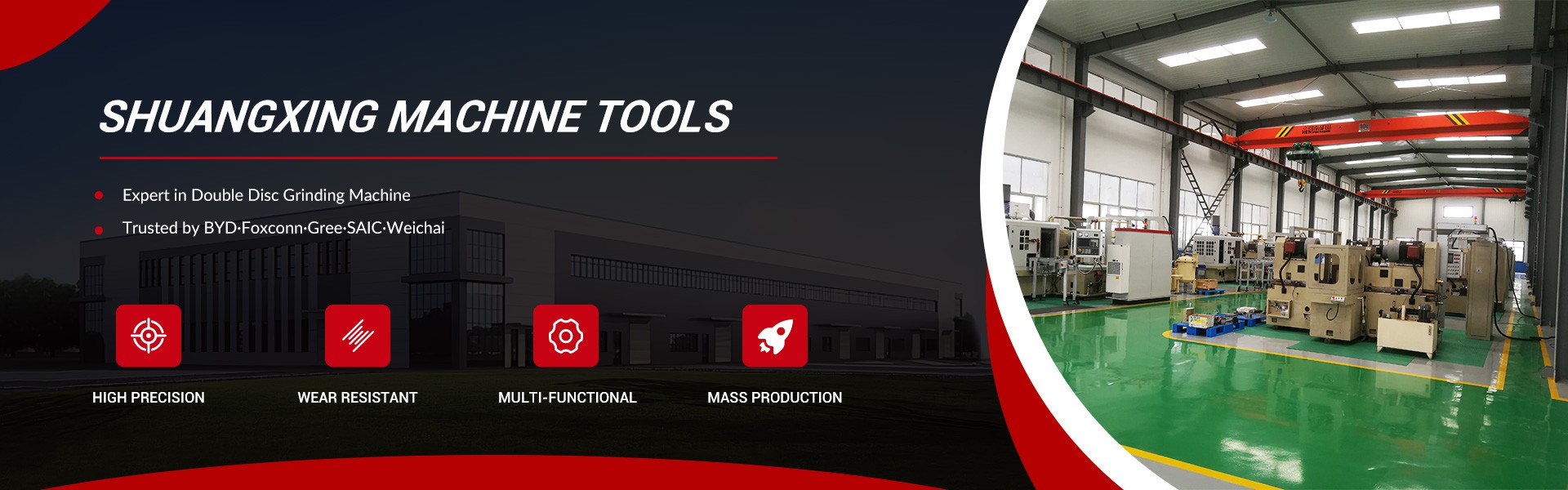
In industrial precision grinding processing, double disc grinding machines and single disc grinding machines are two mainstream grinding equipment, widely used in mechanical parts finishing, precision hardware manufacturing and other fields. Many manufacturers are confused about how to choose between the two devices. By analyzing core differences in processing principle, accuracy, efficiency, cost and applicable scenarios, this article helps enterprises make targeted equipment selection decisions.
The most essential difference lies in the processing principle and working mode. A double disc grinding machine adopts dual opposite grinding disc structure, which can synchronously grind two parallel surfaces of the workpiece in one clamping and one processing cycle. In contrast, a single disc grinding machine only has one grinding disc, which can only process a single surface at a time. For workpieces requiring double-sided finishing, single disc grinders need secondary clamping and repeated positioning, while double disc grinders complete processing in one step.
In terms of processing accuracy and stability, double disc grinding machines have absolute advantages. Secondary clamping and positioning of single disc grinders will inevitably produce cumulative positioning errors, with the overall error up to 0.02mm or more, making it difficult to guarantee high parallelism and flatness of workpieces. The dual-disc synchronous grinding mode of double disc grinding machines eliminates secondary positioning errors, with the parallelism tolerance controlled within ±0.001mm, and effectively avoids single-sided stress deformation of workpieces, ensuring ultra-high surface integrity and dimensional consistency of finished products.
In terms of production efficiency and mass production adaptability, double disc grinding machines far outperform single disc grinders. Industry practical data shows that double disc synchronous grinding can increase processing efficiency by 30% to 50%, and even up to 3 times in batch production scenarios. Taking bearing parts processing as an example, the processing time of a single set of bearing inner and outer rings is shortened from 45 seconds to 12 seconds with double disc grinding equipment. It can realize continuous mass production of tens of thousands of parts per day, which perfectly matches the high-output production needs of modern factories.
In terms of cost and space economy, double disc grinding machines also have comprehensive advantages in long-term operation. Although the initial procurement cost is slightly higher than single disc grinders, it saves multiple costs for enterprises in subsequent production. The one-step forming processing reduces manual operation links, saving labor costs; the low defective rate reduces material waste and rework costs; the optimized structural design reduces factory floor space by 40% and energy consumption by 30%. Single disc grinders have lower initial investment but higher comprehensive operating costs for long-term mass production.
Each equipment has its exclusive applicable scenarios. Single disc grinding machines are suitable for small-batch production, single-sided precision processing of special-shaped workpieces, and customized processing scenarios with low requirements for double-sided parallelism. Double disc grinding machines are the best choice for mass production of symmetrical parts such as bearings, piston pins, hydraulic parts and new energy hardware, especially for manufacturing scenarios with strict requirements for high precision, high consistency and high efficiency.
In conclusion, single disc grinding machines are more suitable for flexible small-batch and single-sided processing, while double disc grinding machines are the mainstream equipment for high-precision and large-scale industrial production. Manufacturers can select equipment according to their workpiece types, batch output and precision standards to optimize production benefits.