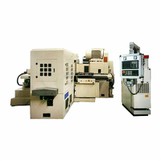

As a supplier of Connecting Rod Production Lines, I've seen firsthand the importance of efficient workpiece transportation methods in the manufacturing process. In this blog, I'll share some of the common transportation methods used in a connecting rod production line and how they contribute to the overall efficiency and productivity of the operation.
Conveyor Belts
One of the most widely used transportation methods in a connecting rod production line is the conveyor belt. Conveyor belts are an excellent choice for moving workpieces between different stages of the production process. They offer a continuous and smooth flow of materials, which helps to reduce bottlenecks and increase throughput.
Conveyor belts come in various types, including flat belts, roller belts, and chain belts. Flat belts are ideal for transporting small and lightweight workpieces, while roller belts are better suited for heavier and larger items. Chain belts, on the other hand, are often used for high-speed and heavy-duty applications.
The Conveyor Belts For Connecting Rods we offer are designed specifically for the unique requirements of connecting rod production. They are made from high-quality materials that can withstand the rigors of the manufacturing environment and provide reliable and efficient transportation of workpieces.
Automated Guided Vehicles (AGVs)
Automated Guided Vehicles, or AGVs, are another popular transportation method in modern connecting rod production lines. These self-guided vehicles are equipped with sensors and software that allow them to navigate through the production facility without the need for human intervention.
AGVs offer several advantages over traditional transportation methods. They can operate 24/7, which helps to increase productivity and reduce labor costs. They are also highly flexible and can be easily reprogrammed to adapt to changes in the production process.
In our Automatic Production Line Of Connecting Rod, we integrate AGVs to ensure the seamless movement of workpieces between different workstations. This not only improves efficiency but also reduces the risk of human error and damage to the workpieces.
Robotic Arms
Robotic arms are increasingly being used in connecting rod production lines to handle the transportation and manipulation of workpieces. These versatile machines can perform a wide range of tasks, including picking, placing, and assembling components.
Robotic arms offer several benefits in a production environment. They are highly precise and can perform repetitive tasks with consistent accuracy. They can also work in hazardous or difficult-to-reach areas, which helps to improve safety and reduce the risk of injuries.
Our Connecting Rod Processing Technology incorporates advanced robotic arms to enhance the efficiency and quality of the production process. These robotic arms are programmed to handle workpieces with care and precision, ensuring that each connecting rod meets the highest standards of quality.
Overhead Cranes
Overhead cranes are commonly used in connecting rod production lines to lift and move heavy workpieces. These cranes are typically installed on the ceiling of the production facility and can be operated manually or automatically.
Overhead cranes offer several advantages in a production environment. They can lift and move large and heavy workpieces with ease, which helps to improve productivity and reduce the risk of injuries. They are also highly flexible and can be used to transport workpieces to different areas of the production facility.


In our production lines, we use overhead cranes to handle the transportation of large and heavy connecting rod components. This ensures that the workpieces are moved safely and efficiently between different workstations, minimizing the risk of damage and downtime.
Pneumatic Systems
Pneumatic systems are another transportation method that can be used in a connecting rod production line. These systems use compressed air to move workpieces through a series of tubes or channels.
Pneumatic systems offer several advantages in a production environment. They are fast, efficient, and can be easily integrated into existing production lines. They are also relatively inexpensive and require minimal maintenance.
In our production lines, we use pneumatic systems to transport small and lightweight workpieces between different workstations. This helps to improve the overall efficiency of the production process and reduce the time and cost associated with manual handling.
Conclusion
In conclusion, there are several transportation methods available for workpieces in a connecting rod production line. Each method has its own advantages and disadvantages, and the choice of transportation method will depend on the specific requirements of the production process.
As a supplier of Connecting Rod Production Lines, we offer a range of transportation solutions that are designed to meet the needs of our customers. Whether you need a conveyor belt, an AGV, a robotic arm, an overhead crane, or a pneumatic system, we have the expertise and experience to provide you with the right solution.
If you're interested in learning more about our Connecting Rod Production Lines or our transportation solutions, please don't hesitate to contact us. We'd be happy to discuss your requirements and provide you with a customized solution that meets your needs.
References
- Industry standards and best practices for connecting rod production.
- Research and development reports on transportation methods in manufacturing.
- Case studies of successful connecting rod production lines.